

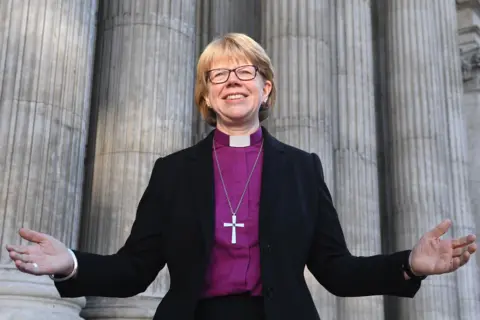
The 63-year-old former NHS chief nurse has been named as the new Archbishop of Canterbury designate - making history as the initial female to be chosen for this prestigious role.
Previously England's chief nursing officer, the 63-year-old entered the priesthood in 2006 and was appointed as the first female Bishop of London in 2018 - occupying the third highest position of clergy in the Church of England.
This signifies the first time in nearly 500 years of tradition that the Anglican Communion has nominated a woman to lead it.
Historic Appointment
The Church has been without someone in the top job for approximately twelve months after Justin Welby stepped down over a protection controversy.
He stepped down following a damning report into a prolific child abuser linked to the religious institution. The report found that he "could and should" have reported John Smyth's abuse of male youths to law enforcement in 2013.
Archbishop of York Stephen Cottrell assumed most of the former Archbishop's responsibilities in an interim move, and was one of the voting members of the body charged with selecting his successor.
Political Procedure
In line with tradition, the procedure of selecting a new archbishop involves a name being given to Prime Minister Sir Keir Starmer and then forwarded to the sovereign.
The Prime Minister has welcomed the selection of Dame Sarah, stating: "This position will play a key role in our country's affairs. I offer my best wishes and look forward to working together."
While, technically, the monarch is head of the Anglican Church, the person holding the role of Archbishop of Canterbury is the highest-ranking cleric and is the spiritual leader of the religious institution and the global Anglican community.
Monarchical and International Response
The monarch has congratulated the new Archbishop on her new role, "a position of great significance in the UK and across the global Anglican Communion", the royal household said.
The Global Fellowship of Confessing Anglicans, which represents conservative views, has questioned the selection, saying that although certain groups support the decision, "the majority of the Anglican Communion still believes that the scriptures mandates a male-only episcopacy."
Handover Process
She does not legally take on her new role until a confirmation of election in the new year, and an installation ceremony comes later, after they have pledged allegiance to the King.
In a statement on Friday after her appointment was finalized, she said: "I know this is a significant undertaking but I approach it with a feeling of calm and faith in divine guidance to carry me as He always has."
Speaking from the historic church, she said that "in an age that craves certainty and tribalism, Anglicanism offers something quieter but more resilient."
Addressing Violence
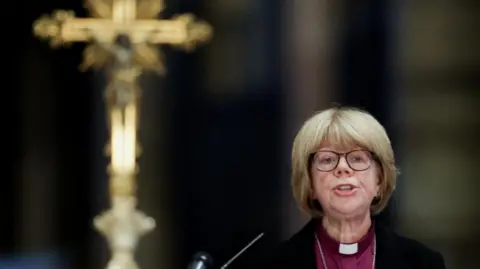
Addressing the "terrible attack" of the previous day's incident on a Jewish house of worship in Manchester, she stated "we observe prejudice that emerges through fractures across our communities."
She continued: "We then as a Church have a duty to be a people who stand with the Jewish people against antisemitism in all its forms. Hatred and racism of all types cannot be permitted to tear us apart."
Background and Career
Married with two children, she devoted more than three decades in the NHS, achieving the position of the youngest-ever chief nursing officer for the country in 1999.
While serving voluntarily in the Church at the period, it was just a short time after that she chose to enter a priest and was promptly assigned helping make reforms in the way the institution addressed abuse.
In 2012 she became canon treasurer at the historic church before becoming diocesan leader in the diocese of Exeter in 2015.
As London's religious leader she was regarded as someone who applied her background as an NHS administrator to help update the diocese.
Personal Philosophy
"I am often asked what it has been like to have had different professional paths, first in the NHS and currently in the Church.
"I prefer to think that I have consistently maintained a single calling: to follow Jesus Christ, to know him and to make him known, always seeking to demonstrate empathy in the assistance to people, whether as a healthcare professional, a religious leader, or a bishop."
Future Challenges
Possibly the most urgent thing in her in-tray is still to chart a better path towards dealing with misconduct and treating with more compassion those impacted by such incidents.
There has also been a decline in religious participation, though the capital has to some extent resisted this pattern.
One of the areas she has been particularly vocal on is assisted dying - she is a strong critic, as was her preceding Archbishop.
When legislation was approved in the Commons, she characterized it as "unworkable and unsafe and creates danger to the most at-risk individuals in our community."
Progressive Stances
One of her roles as London's religious leader was to lead a committee trying to guide the Church's decision on whether to sanction gay unions.
She characterized the decision to ultimately permit clergy to bless same-sex couples in last year as "an optimistic development for the Church."
Rowan Williams, summarised her position as requiring a "newspaper in one hand and a understanding of scripture."
Dr Williams explained to journalists "the pressure of having an opinion on everything is quite heavy."
